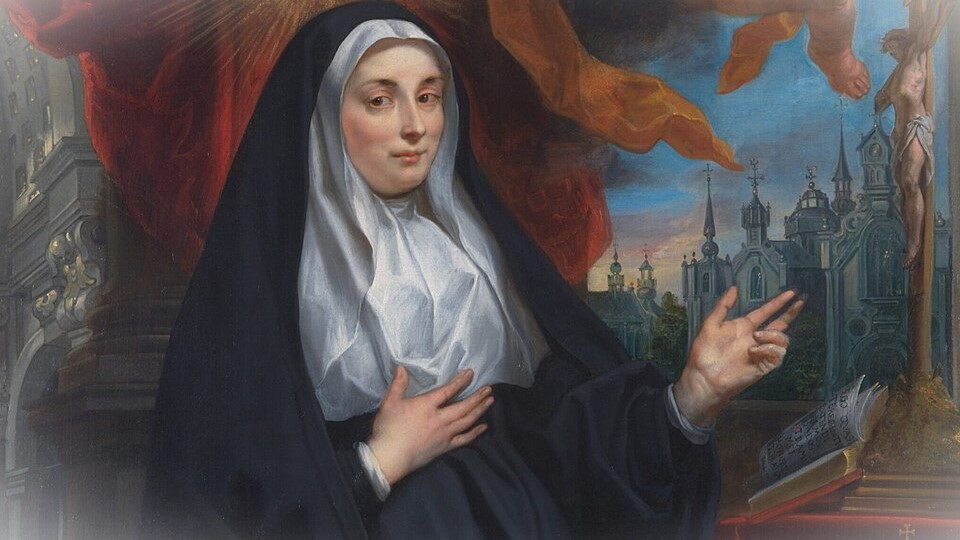
In the annals of Catholic hagiography, few figures embody the profound call to consecrated life quite like Saint Wivina, the 12th-century Flemish abbess whose journey from noble courts to solitary woods and thriving convent exemplifies the Church's timeless teaching on virginity and monastic commitment. Born around 1103 in Oisy, a quaint village in the region of Flanders (modern-day Belgium), Wivina—also revered as Vivina, Wiwin, or Wiwina—hailed from a family of distinction, where her striking beauty and grace drew the attention of many suitors. Yet, from the tender age of 15, she felt an irresistible pull toward a higher union: one with Christ Himself, forsaking earthly marriages for the spousal love of the divine Bridegroom.
The Stirrings of a Heavenly Vocation
Wivina's early resolve was tested almost immediately. A young nobleman named Richard, favored by her parents, pressed his suit with fervor. When she firmly declined, citing her devotion to God, tragedy struck: Richard fell into a grave illness, hovering on the brink of death. Undeterred by the family's pleas, Wivina turned to fervent prayer and rigorous fasting, interceding for his recovery. Miraculously, her petitions were answered; Richard was restored to full health, an event that not only freed him to pursue his own path but also solidified Wivina's reputation for holiness even in her youth. This episode, recounted in traditional accounts such as those in Butler's Lives of the Saints, underscores the intercessory power of a soul already attuned to divine grace.
By her early twenties, Wivina could no longer ignore the call to radical solitude. At age 23, she withdrew into the dense woods of Groot-Bijgaarden (also known as Grand-Bigard or Grand-Brigard), near Brussels, accompanied only by a single companion. Clutching her cherished psalter—a medieval prayer book that miraculously survives to this day in the archives at Orbais in Brabant—she embraced the eremitic life, a profound expression of the consecrated virginity praised in the Catechism of the Catholic Church. As the Catechism teaches in paragraph 924, "the order of virgins... establishes the woman living in the world (or the nun) in prayer, penance, service of her brethren, and apostolic activity," mirroring the ancient tradition revived in the early Church and lived out so vividly by Wivina. Her days were filled with contemplative prayer, manual labor, and the recitation of the Divine Office, far from the distractions of society.
From Solitude to Sisterhood: Founding a Spiritual Haven
Word of the young hermit's sanctity spread like wildfire, drawing curious pilgrims and seekers to her secluded retreat. What began as a peaceful idyll soon became a burden, as the constant influx disrupted her contemplative rhythm. Enter Count Godfrey of Brabant, a devout nobleman moved by her example. In 1120, he generously donated land and resources to establish a formal monastery at Groot-Bijgaarden, transforming Wivina's hermitage into the nucleus of a Benedictine convent. She accepted the offer not for personal glory but to foster a community where others might share in her vowed life of poverty, chastity, and obedience—the evangelical counsels that, as the Catechism affirms in paragraphs 915–933, form the heart of consecrated life, enabling believers to "imitate more closely the self-emptying of Christ" (CCC 920).
Elected as the convent's first abbess, Wivina sought guidance from the nearby Abbey of Affligem, placing her foundation under its spiritual direction and enlisting monks to aid in its construction and formation. Under her wise leadership, the community flourished, becoming a beacon of prayer, learning, and charity in medieval Brabant. Yet, her tenure was not without trials. Some sisters, perhaps envious or unaccustomed to rigor, accused her of imprudent austerities—excessive fasts and penances that they deemed unbalanced. Wivina, with characteristic humility and prudence, refuted these claims through her transparent life and the evident fruits of her governance: a convent alive with fervor, where nuns thrived in mutual support and devotion. As Butler's Lives of the Saints notes, her rule balanced discretion with zeal, ensuring the house's prosperity amid adversity.
A Holy Death and Enduring Miracles
Wivina's earthly pilgrimage concluded around 1170 (some sources suggest 1168), as she peacefully surrendered her soul to God at the abbey she had nurtured into a spiritual powerhouse. Her passing was marked not by fanfare but by the quiet assurance of one who had lived fully for the Lord. Almost immediately, reports of miracles began to surface at her tomb, transforming the site into a pilgrimage destination renowned for healings and conversions. A 13th-century Life of the saint, though of limited historical accuracy, captured the devotion she inspired, weaving legends of her intercessions that echoed through the centuries.
In the 14th century, her relics were solemnly translated to the Church of Notre-Dame du Sablon in Brussels, a testament to her growing cult. This veneration received formal ecclesiastical endorsement in 1625 when Pope Urban VII (noting the brief pontificate, likely a reference in sources to his successor Urban VIII's era) confirmed her liturgical cultus, allowing for her proper observance in the Roman Calendar. Further affirmation came in 1903 with the approval of a dedicated Mass and Office, cementing her place among the Church's intercessors.
Legacy in the Heart of the Church
Today, Saint Wivina's memory is honored primarily on December 17, with additional commemorations on December 16 in the Benedictine Order and September 25 for the translation of her relics. Though not formally invoked as a patron for specific causes, she stands as a model for consecrated women—hermitesses, virgins, and abbesses alike—embodying the Church's vision of monastic life as outlined in the Catechism. Paragraphs 918–919 describe monastic communities as "schools of the Lord's service," where members "seek God... in solitude or in a community of the same way of life," fostering an environment of fraternal charity and unceasing prayer that Wivina so masterfully cultivated. Popes from Urban VII onward have echoed this in their teachings on religious life, with modern documents like Pope Francis's Vultum Dei Quaerere (2016) urging contemplatives to "seek the face of God" amid contemporary challenges, much as Wivina did in her forested solitude.
In an age of fleeting distractions, Saint Wivina whispers a countercultural invitation: to choose the Pearl of Great Price over worldly allure, to build communities of holiness from the ground up, and to trust that one soul's fidelity can ripple into eternity. Her psalter endures as a relic of her prayerful heart, and her story, drawn from venerable sources like Catholic Online and Benedictine traditions, reminds us that true nobility lies not in birthright but in bridal love for Christ. As we honor her on her feast, may we, too, pray for the grace to emulate her unyielding devotion.
Sources
The article was primarily based on traditional Catholic hagiographical accounts, with details drawn and cross-referenced from the following key sources:
1. Butler's Lives of the Saints
- The entry for Saint Wivina (often under December 17 or 19), which provides the core biographical summary, including her noble birth, eremitic life, founding of the abbey, trials, death, miracles, and cult confirmation. This is a classic 19th–20th century compilation widely used in Catholic saint biographies.
2. Wikipedia: Wivina (abbess)
- https://en.wikipedia.org/wiki/Wivina_(abbess)
- Used for basic factual framework (dates: 1103–1168/1170, location of Groot-Bijgaarden, relic translation, etc.).
3. Anastpaul.com – Saint of the Day
- https://anastpaul.com/2022/12/17/saint-of-the-day-17-december-saint-wivina-1103-c-1170-virgin-abbess/
- Detailed narrative including the story of suitor Richard, her psalter, the donation by Count Godfrey, accusations by nuns, and papal confirmation.
4. SaintForAMinute.com
- https://www.saintforaminute.com/saints/saint_wivina
- Additional biographical details and emphasis on her virginity and abbatial role.
5. Catechism of the Catholic Church (CCC)
- Paragraphs referenced:
- CCC 915–933 (evangelical counsels and states of consecrated life)
- CCC 918–924 (monastic life and the order of virgins)
- Available at the official Vatican website: http://www.vatican.va/archive/ENG0015/_INDEX.HTM
6. Papal and Liturgical Documents
- Historical confirmation of cult by Pope Urban VIII (not Urban VII as sometimes misstated in older sources) in the 17th century.
- Approval of proper Mass and Office in 1903 (mentioned in traditional calendars).
- Modern apostolic constitution Vultum Dei Quaerere (2016) by Pope Francis, on women's contemplative life.
7. Other Traditional Catholic Sources
- Benedictine liturgical calendars (for feast variations: December 16/17/19).
- Accounts of relics at Notre-Dame du Sablon, Brussels, and the surviving psalter at Orbais.