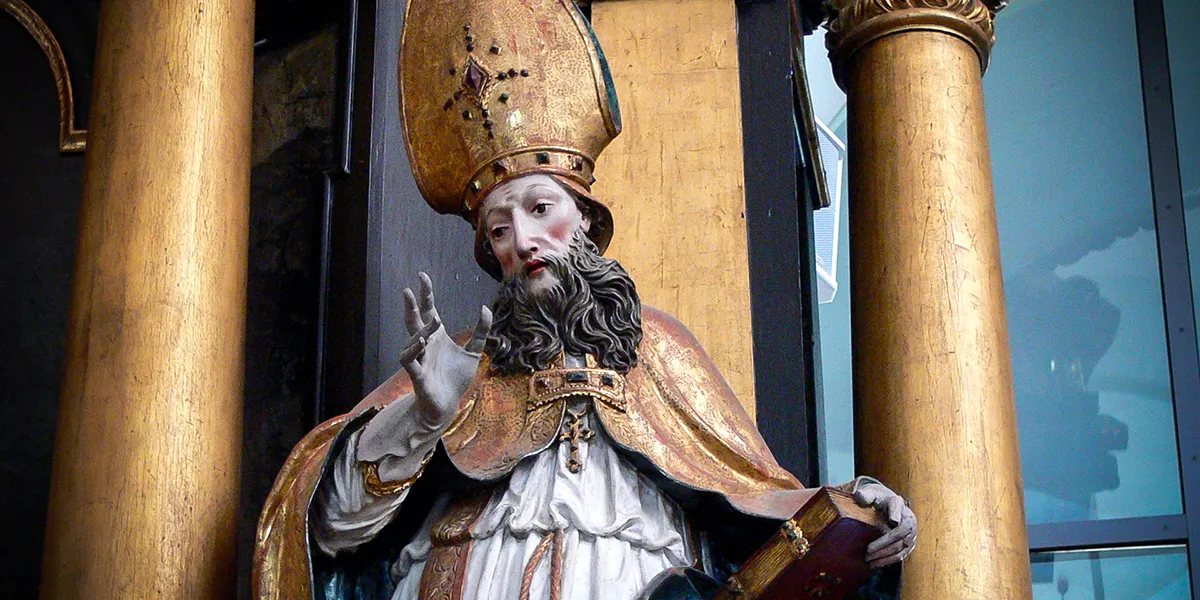
Saint Hilary of Poitiers stands as one of the most influential figures in early Christianity, renowned for his unwavering defense of the divinity of Christ against the Arian heresy that threatened the very foundations of the faith in the fourth century. Born around 310 in Poitiers, Gaul (modern-day France), into a noble and affluent pagan family, Hilary received an exceptional education in rhetoric and philosophy. Yet, despite his intellectual gifts, he was plagued by profound existential questions: the purpose of life, the source of true happiness, and the inevitability of death. His search for truth led him through classical literature, but it was the Scriptures that ultimately illuminated his path. Encountering the divine declaration in Exodus, "I am who I am" (Ex 3:14), filled him with awe, yet the specter of mortality persisted until he delved into the Gospel of John, where the themes of Incarnation and Resurrection provided the fulfillment he sought. Around the age of 30, in approximately 345, he embraced baptism, marking his conversion to Christianity.
Hilary's intellectual prowess and spiritual depth quickly drew the attention of the Christian community in Poitiers. Despite being married and a father (his daughter Abra would later be venerated as a saint), he was elected bishop around 353, against his initial reluctance. As bishop, Hilary became a pillar of orthodoxy in a time when Arianism—a heresy denying the full divinity of Jesus Christ, viewing Him instead as a created being—had gained significant traction, even among emperors and bishops. He encountered Saint Athanasius of Alexandria, the great Eastern defender of Nicene orthodoxy, who was exiled in Gaul at the time. This meeting strengthened Hilary's resolve to combat Arianism, earning him the moniker "Athanasius of the West."
His opposition to Arianism soon led to conflict. At the Synod of Béziers in 356, dominated by Arian sympathizers, Hilary refused to condemn Athanasius, resulting in his exile to Phrygia (in modern-day Turkey) by Emperor Constantius II. Far from silencing him, exile provided Hilary an opportunity to deepen his theological insights. Immersed in Greek patristic thought, he composed his masterpiece, De Trinitate (On the Trinity), a twelve-book treatise that masterfully integrated Greek nuances into Latin theology, making him the first Latin Father to bridge these traditions so effectively. In this work, Hilary articulated the consubstantiality (homoousios) of the Father and the Son, drawing from the Nicene Creed of 325 to affirm Christ's eternal divinity.
Pope Benedict XVI, in his general audience on October 10, 2007, highlighted Hilary's contributions: "In his principal work, De Trinitate, Hilary sets forth his personal journey toward the knowledge of God and demonstrates that Scripture clearly attests to the divinity of the Son, his likeness to the Father in the Gospel as well as in the Old Testament, which unveils the mystery of Christ." Benedict further noted Hilary's emphasis on the baptismal formula: "in the name of the Father, and of the Son, and of the Holy Spirit" (Mt 28:19), which forms the basis of Trinitarian theology. Despite his firm stance, Hilary was known for a conciliatory spirit, seeking to guide those who acknowledged the Son's similarity to the Father toward full acceptance of their equality in divine nature. As Benedict observed, "Being all love, God is able to communicate his full divinity to the Son... By assuming human nature, the Son united himself to every man... which is why the way to Christ is open to each of us... if there is personal conversion."
Saint Jerome, reflecting on the pervasive spread of Arianism during this era, lamented, "The world groaned and marveled to find that it was Arian." Hilary's exile ended around 361 following Constantius's death, allowing his return to Poitiers under the more tolerant Emperor Julian. Upon returning, he continued his anti-Arian campaign, participating in councils like that of Paris in 361, which condemned Arian bishops in Gaul. He also supported monasticism by welcoming Saint Martin of Tours, who founded the monastery at Ligugé near Poitiers—the oldest in Western Europe. Hilary's later works include commentaries on the Psalms and the Gospel of Matthew, emphasizing allegorical and mystagogical interpretations for the edification of his flock.
The Catechism of the Catholic Church draws upon Hilary's theology in elucidating the Trinity. In paragraph 240, it references his Commentary on Matthew (In Matth. 2,5) to underscore the eternal relational Fatherhood of God: "Jesus revealed that God is Father in an unheard-of sense: he is Father not only in being Creator; he is eternally Father in relation to his only Son, who is eternally Son only in relation to his Father." This citation (PL 9, 927) affirms the mutual knowledge between Father and Son, highlighting their consubstantial unity without compromising their distinct persons.
Hilary's own words capture his profound devotion and theological acuity. He wrote, "The Church is the Ship outside which it is impossible to understand the Divine Word, for Jesus spoke from the boat to the people gathered on the shore." On the Incarnation, he proclaimed, "He by Whom man was made had nothing to gain by becoming Man; it was our gain that God was incarnate and dwelt among us, making all flesh His home by taking upon Him the flesh of One." His Marian piety is evident in his recognition of Mary's perpetual virginity and role in redemption, as he saw her as the model of faithful humanity accepting God's salvific plan.
Despite being labeled a "disturber of the peace" like his Master, Hilary was a gentle, courteous man whose holiness shone through scholarship and controversy. He died in Poitiers around 367 or 368, and his feast is celebrated on January 13. In 1851, Pope Pius IX elevated him to Doctor of the Church, recognizing his enduring contributions to Trinitarian doctrine.
Saint Hilary's life reminds us that true faith demands both intellectual rigor and pastoral charity. In an age of doctrinal turmoil, he exemplified how to defend truth with patience, bridging East and West while fostering unity. His legacy endures in the Church's teachings, inviting all to encounter the Triune God through Scripture and sacrament.
List of Sources Used
- Diocese of Poitiers website (historical notes on Saint Hilary and local saints).
- Benedict XVI's General Audience on Saint Hilary of Poitiers (October 10, 2007), Vatican.va.
- Catechism of the Catholic Church, paragraphs 240 and related footnotes (referencing Hilary's In Matth. 2,5).
- Saint Jerome's writings on the Arian crisis.
- Hilary of Poitiers' De Trinitate and other quotes compiled in Catholic resources.
- Venantius Fortunatus' Vita S. Hilarii (biographical illumination).
- Historical accounts from the Diocese of Luçon and other French diocesan sources on Hilary's evangelization efforts.